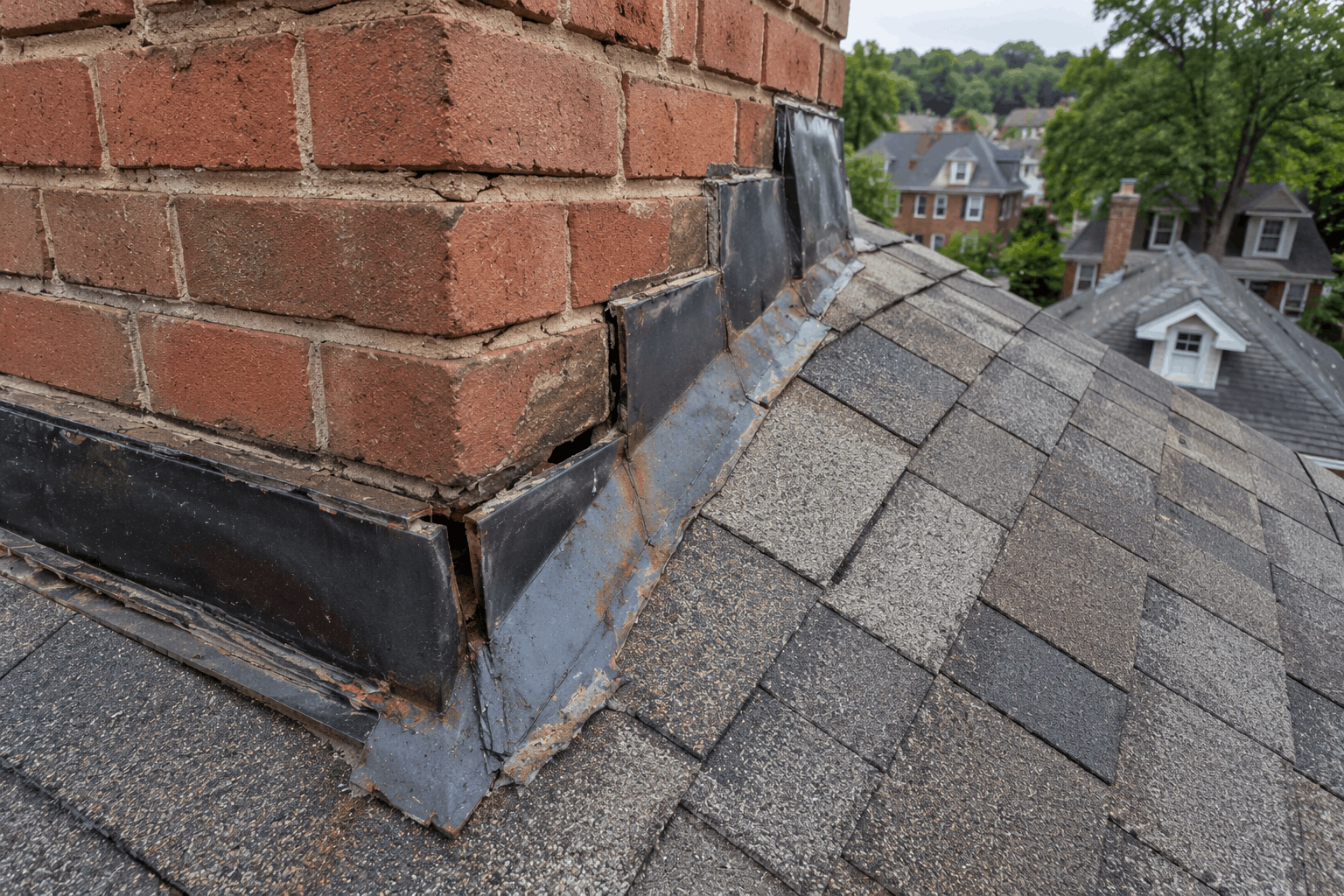
Of all the roof leaks we troubleshoot in Pittsburgh, failed flashing accounts for the biggest share. A lot of homeowners have a 10 to 15-year-old roof with shingles that look fine, but they’ve got a ceiling stain that they can’t pin down. Almost every time, the culprit is failed flashing somewhere on the roof.
Pittsburgh is particularly hard on flashing because of four specific local stressors that hit harder here than in milder markets: every winter’s ice dams stress the step flashing around chimneys, freeze-thaw cycling cracks the sealant in valleys, urban soot and acid rain accelerate metal corrosion on older homes, and prior repairs often replaced proper step flashing with cheaper continuous flashing that doesn’t last.
Got a mystery leak you can’t find? Call us at (724) 581-8147 or schedule a free inspection here. We’ll find the actual source (it’s almost always the flashing), document it with photos, and tell you what the fix runs.
What Roof Flashing Is and Where It Lives
Roof flashing is thin metal (aluminum, galvanized steel, or copper on premium homes) installed wherever the roof transitions to another surface. Its job is to direct water away from those transitions. Without flashing, water would pour into your house at every chimney, valley, and wall intersection.
The main flashing locations on a typical Pittsburgh home: chimney step flashing (the single most failure-prone location on Pittsburgh roofs), valley flashing, skylight flashing, vent pipe boots, dormer flashing, wall flashing, and drip edge along the eaves.
The Four Real Causes of Pittsburgh Flashing Failure
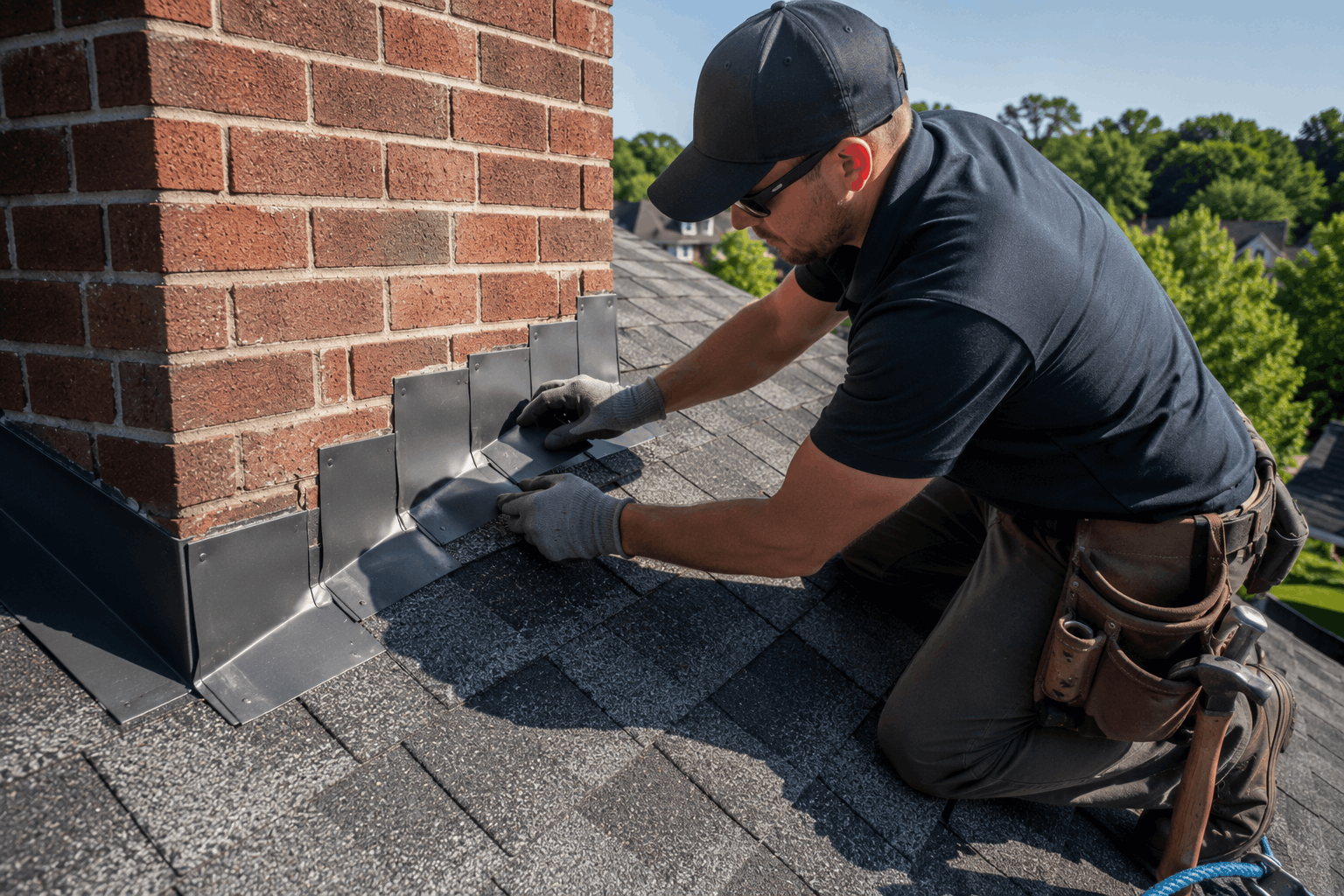
1. Metal corrosion. Older homes (pre-1980) often have galvanized steel flashing that wasn’t designed for Pittsburgh’s industrial-era acid rain. Even modern aluminum flashing eventually pits and corrodes in this climate.
Once the metal degrades, water works past it.
2. Failed sealant. The caulking and sealants used to bed flashing have a real-world life of 10 to 15 years in our freeze-thaw climate. After that, the sealant cracks, pulls away, and stops doing its job. Failed sealant looks like dried, brittle caulking with visible gaps or separation from the metal.
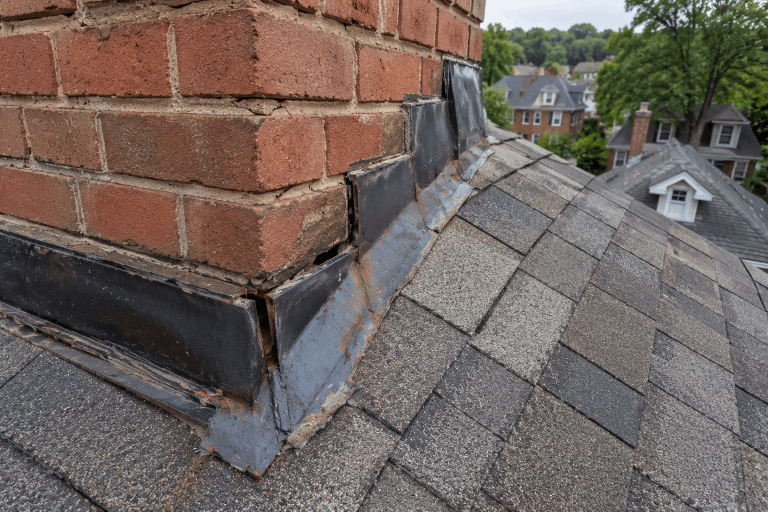
3. Step flashing replaced with continuous flashing on a prior repair. Step flashing is supposed to be installed as individual pieces interleaved with each shingle course around chimneys. It’s labor-intensive to install correctly.
Some contractors replace failed step flashing with a single continuous strip of metal sealed with caulk. It’s faster but fundamentally wrong. The first time water gets behind the caulk, it has nowhere to escape and ends up inside your house.
Pittsburgh has thousands of homes where this shortcut was taken on a prior repair, and we replace those failed jobs constantly. (For broader pricing context, see our Pittsburgh roof repair page.)
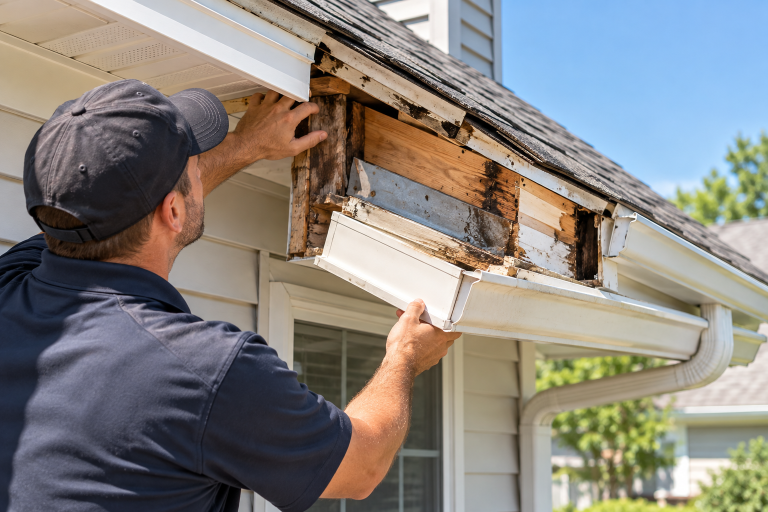
4. Physical lift or pull-away. Wind, ice expansion, or chimney settlement can lift flashing off the substrate.
Once flashing lifts at a corner, every rainstorm pulls more water in until the visible problem becomes a leak. Severe wind events compound this fast; if you’re staring at a sudden leak after a storm, wind damage roof repair is its own diagnostic path.
Pittsburgh-Specific Stressors
Ice dam pressure on step flashing. Every Pittsburgh winter, ice dams form along eaves and around chimneys. The weight and lateral pressure of ice expansion stresses the step flashing. After a few hard winters, the flashing starts pulling away from the masonry.
Pittsburgh homes typically see flashing pull-away 5 to 10 years sooner than homes in milder climates.
Freeze-thaw cycles cracking caulk. Pittsburgh averages 50+ freeze-thaw cycles per winter. Each cycle, the caulking around flashing expands and contracts. Even modern silicone sealants have limited flexibility. After enough cycles, the caulking cracks and lifts.
Urban soot and acid rain. Pittsburgh’s industrial history is gentler now than 50 years ago, but acidic precipitation continues to accelerate metal corrosion, especially in neighborhoods near the rivers (South Side, North Side, Strip District, Lawrenceville). Flashing on a home in Highland Park may last 15 years longer than identical flashing on a home in the South Side.
Older brick chimneys. A huge percentage of Pittsburgh homes have original brick chimneys from the early-to-mid 20th century. The mortar between bricks deteriorates over time, especially at the roof line where step flashing is keyed into the masonry.
Once the mortar starts going, the flashing can’t seal against the chimney properly anymore.
Warning Signs Inside the House
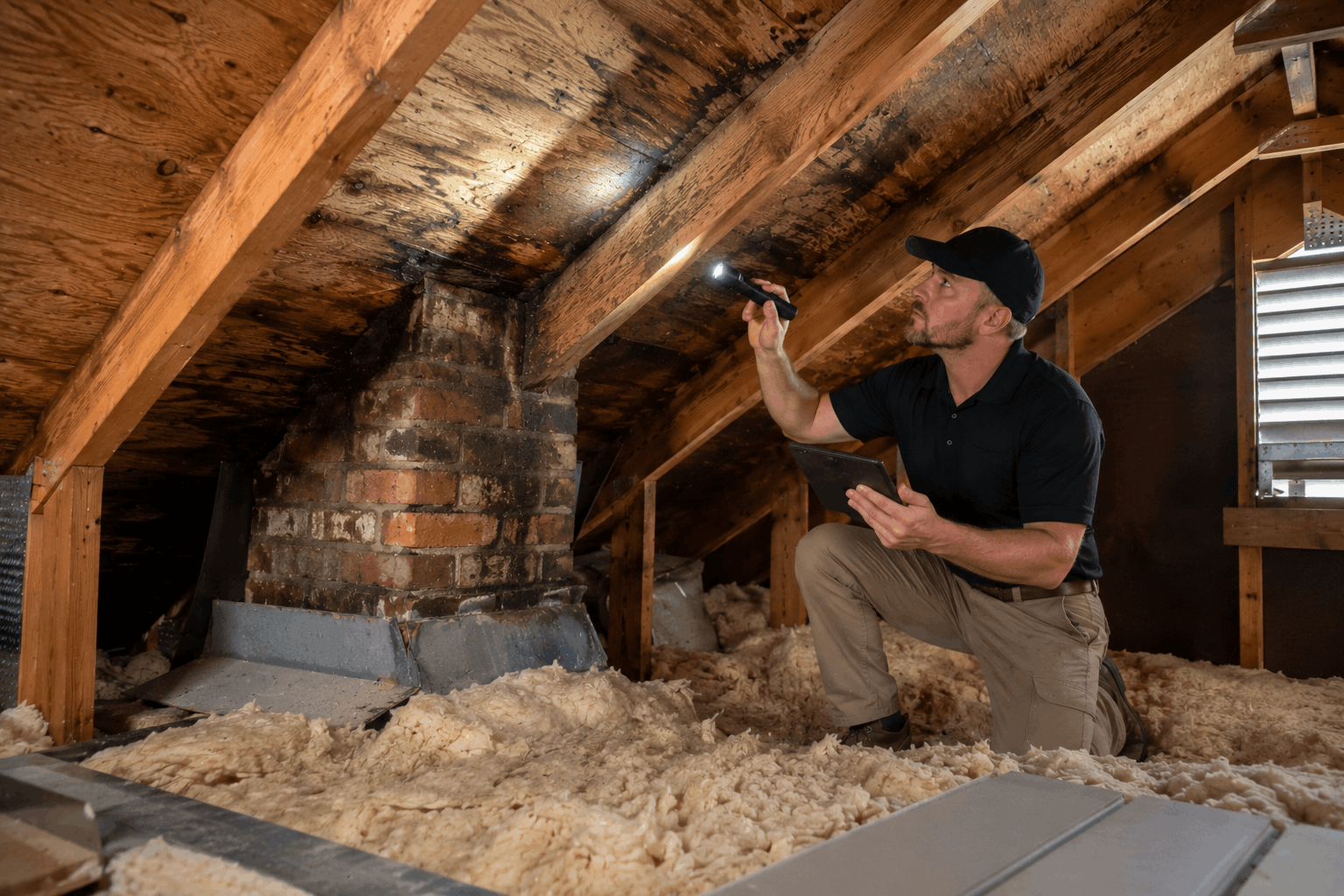
Failed flashing often shows up inside before you see anything from the roof:
- Ceiling stains near a chimney. Brown or yellow rings on the ceiling close to where the chimney passes through.
- Water in the firebox after heavy rain. Usually means the chimney crown or flashing is failing.
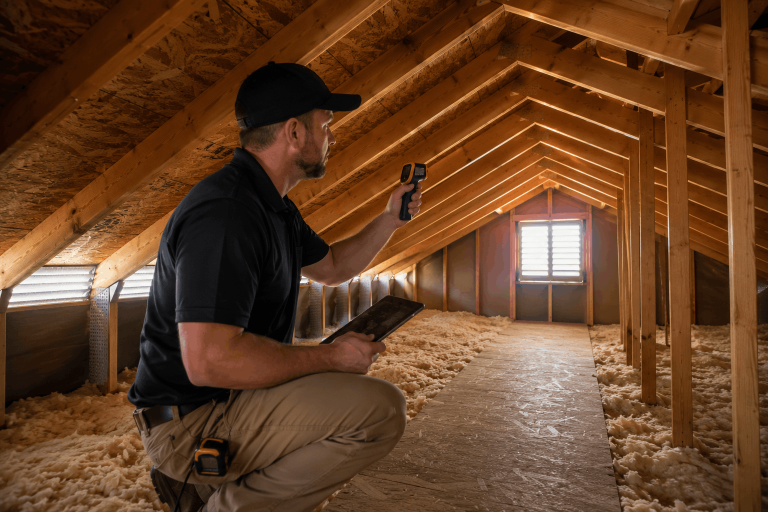
- Damp insulation in the attic near a roof penetration. Touch it during a wet stretch.
- Shiny nail heads in the attic deck. Visible condensation on nails near chimneys or other flashing locations.
- Mold growth or musty smell localized to areas under a known flashing location. If you’re also noticing high attic humidity, see the warning signs of poor attic ventilation, which often compounds flashing problems.
- Water pooling in the fireplace, dripping from a recessed light, or staining drywall after a storm.
Warning Signs Outside the House
From a ladder or on the roof:
- Lifted or pulled-away flashing at the chimney or wall edges
- Cracked or missing caulking visible at flashing seams
- Rust streaks on the shingles below a flashing location (means the metal is corroding)
- Visible gaps between flashing and the chimney or wall
- Continuous flashing where step flashing should be (look for one long strip of metal instead of individual interleaved pieces)
- Damaged shingles adjacent to flashing (often happens when flashing failure lets water work sideways under nearby shingles)
What the Fix Usually Looks Like
Depends on what failed and how badly:
- Recaulk only ($200 to $500). Works when the metal flashing is sound but the sealant has just dried out and cracked. Extends life 3 to 7 years.
- Repair step flashing ($400 to $1,500 per chimney). When individual flashing pieces have lifted or corroded but the underlying layout is correct.
- Full chimney flashing replacement ($800 to $2,500). When the flashing was installed wrong (continuous instead of step), or when the chimney masonry has degraded enough that proper flashing needs to be reset into the mortar joints.
- Valley flashing replacement ($600 to $2,000). Valleys handle the highest water volume on the roof. Once valley flashing fails, prompt replacement is critical to prevent deck damage.
- Skylight flashing replacement ($500 to $1,500). Often the only fix when a skylight has been leaking, because the original install rarely allows clean partial repair.
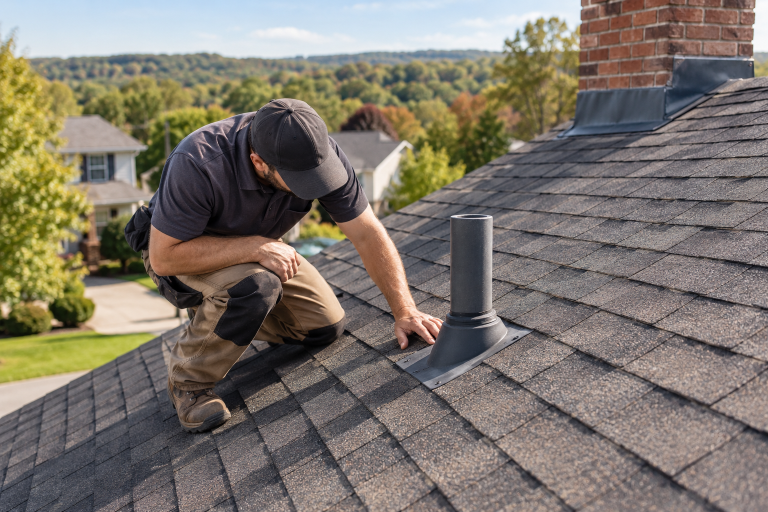
- Vent boot replacement ($200 to $500). Cracked rubber boots are an easy, inexpensive fix that solves a surprising percentage of mystery leaks.
Common Pittsburgh Flashing Failure Patterns
After years of working on Pittsburgh roofs, we see consistent patterns:
1920s-1950s homes with original brick chimneys. Step flashing fails at the chimney, often on the side facing into prevailing winds. Common in older Squirrel Hill, Mt. Lebanon, Bethel Park, and Highland Park.
1960s-1980s ranch and split-level homes. Plumbing vent boots crack from UV and freeze-thaw. The rubber portion is the failure point. Common in suburban South Hills and North Hills.
1990s-2010s newer construction. Skylight flashing failures, particularly on skylights more than 10 years old. The factory flashing kits weren’t designed for Pittsburgh’s freeze-thaw intensity.
Homes that have been reroofed once. About 60% of the flashing failures we see on reroofed Pittsburgh homes trace back to continuous flashing installed instead of step flashing. The contractor who did the reroof took the shortcut.
This is one of the first things we flag during a real professional inspection.
Quick Answers
Is flashing covered by insurance? Generally yes if the damage is from a covered event (hail, wind, falling tree). No if the failure is age-related wear.
Most flashing failures fall into the wear category, meaning out of pocket.
Can I patch flashing or does it need full replacement? Depends. Recaulking works if the metal is sound. Patches with roofing cement are usually temporary fixes that last 1 to 3 years. Full replacement is necessary when the metal has corroded or the install was wrong to begin with.
How long does new flashing last? Properly installed step flashing with quality materials lasts 25 to 40 years in the Pittsburgh climate. Sealant components need reapplication every 10 to 15 years.
Why does my chimney leak only during heavy rain? Heavy rain creates enough water volume to overwhelm partially-working flashing. Lighter rain doesn’t put enough water in contact with the failed seal to leak through. Flashing that “only leaks sometimes” is still failing flashing.
Roofer or chimney sweep for a chimney leak? For a leak around the flashing where it meets the roof: a roofer. For a leak from the chimney itself (cracked crown, deteriorated mortar, missing cap): a chimney mason. Often the right call is both.
Why Pittsburgh Homeowners Call Us
Gotcha Covered Contracting has been on Pittsburgh roofs through every kind of weather for years. Locally owned Pennsylvania company, GAF and Owens Corning certified, fully licensed and insured, Pennsylvania HIC registered. We install step flashing correctly, not the shortcut continuous version that fails in five years.
Book a Free Flashing Inspection
If you suspect flashing failure (ceiling stains, mystery leaks, visible lift or corrosion on the roof), the cheapest path forward is a free professional inspection. We’ll identify where the flashing is failing, quote the repair, and explain your options. Schedule a free Pittsburgh inspection online!
We service Pittsburgh and Allegheny County, including Mt. Lebanon, Squirrel Hill, North Hills, South Hills, Cranberry, Sewickley, Highland Park, and surrounding communities.